The Open Rate Tells You Almost Nothing
Your email client says the prospect opened your proposal. What does that tell you? That their mail server downloaded the tracking pixel. It does not tell you whether they read the executive summary. It does not tell you whether they scrolled to the pricing section. It does not tell you whether they forwarded it to the CFO, or whether it sat open in a browser tab for six hours while they worked on something else.
For consulting firms - where a single engagement can represent $50,000 to $500,000 in revenue - the difference between "opened" and "read page 7 of 12 for three minutes" is the difference between guessing and knowing.
Document analytics replaces the binary signal (opened/not opened) with a behavioral map of how each stakeholder interacts with every page of every document you share. This changes how you sell, how you deliver, and how you manage client relationships.
What Document Analytics Measures
Open rates track a single event: did the recipient's client load the message. Document analytics tracks a continuous stream of interactions across the entire document.
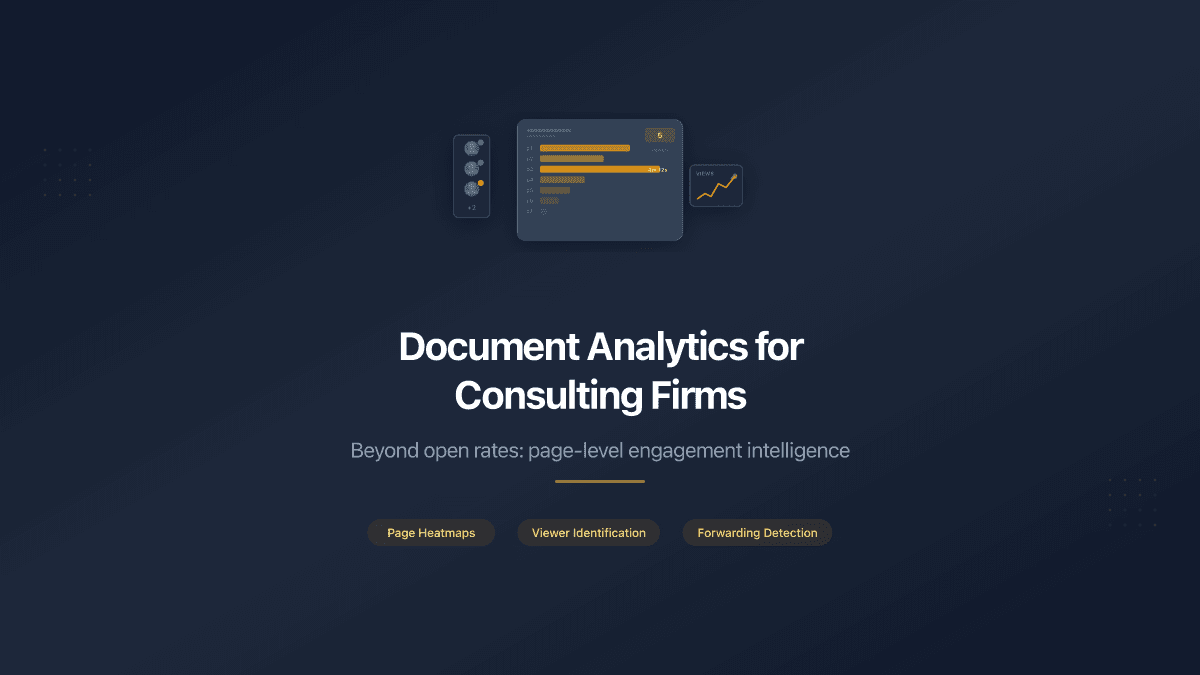
Page-level engagement. Not "they opened the PDF" but "they spent 4 minutes on page 3 (scope of work), 45 seconds on page 6 (team bios), and never reached page 9 (terms and conditions)." This granularity exists because the document renders in a browser-based viewer that records scroll position, page transitions, and time on each page.
Viewer identity. When you share a document link with email verification, each viewer is identified by their email address. You know that jane@client.com viewed the proposal at 9:14 AM on Tuesday and that mike@client.com - who was not on the original email - viewed it at 3:47 PM the same day. Someone forwarded it internally.
Session history. A single viewer may return to the document multiple times. The analytics show each session separately - first visit on Monday (skimmed pages 1-4), second visit on Wednesday (deep read of pages 5-8), third visit on Friday (went straight to the pricing page). The pattern reveals where they are in their decision process.
Forwarding detection. When a document shared with one person is accessed by others, the analytics show the expanded audience without you having to ask "did you share this with your team?" You see new viewers appearing organically.
Document analytics tracks page-by-page viewing behavior, viewer identity, session history, and forwarding patterns - turning a shared document from a static file into a source of client intelligence.
Five Signals That Change How You Follow Up
Raw data is not useful until it maps to action. Here are five patterns that document analytics reveals and what each one means for your follow-up strategy.
1. The Pricing Deep-Read
The viewer spent 60% of their time on your fee schedule and payment terms. They read the pricing section multiple times across separate sessions.
What it means: Price is the primary evaluation criterion. They are comparing your fees against competitors or an internal budget.
How to respond: Lead your follow-up with value justification, not scope clarification. Reference the specific deliverables that map to the pricing they studied. If your proposal includes tiered options, highlight the differences between tiers.
2. The Scope-Only Skim
The viewer read the scope of work and methodology sections carefully but spent less than 30 seconds on everything else - including pricing.
What it means: They are evaluating your approach, not your cost. This is common in technical consulting where the buyer cares about methodology (can you do the work?) more than price (how much does it cost?).
How to respond: Follow up with depth on your methodology. Share a relevant case study or reference project. Do not lead with a discount - they are not thinking about price.
3. The Late-Night Executive Read
The document sat untouched for a week. Then someone new - a C-level email address - accessed it at 11 PM and read the executive summary and pricing in one sitting.
What it means: The proposal has been escalated to a decision-maker. The assistant or project lead reviewed it first, and it passed their filter. The executive is now evaluating the commercial terms.
How to respond: This is your highest-intent signal. Follow up promptly, but direct your message to the executive's priorities: business outcomes, risk mitigation, ROI. Not the technical details that satisfied the project lead.
4. The Ghost
The email tracking pixel fired. The document was never opened. Two weeks have passed.
What it means: The proposal did not make it past the inbox. The recipient may be busy, uninterested, or waiting for internal alignment before reviewing external proposals.
How to respond: Re-share the document through a different channel. Send a brief message referencing a specific insight from the proposal that relates to a challenge they mentioned. Give them a reason to open it.
5. The Committee Review
Five different people at the client organization viewed the document within a three-day window. Each spent time on different sections - one on scope, one on pricing, one on team qualifications, one on timeline.
What it means: A buying committee is evaluating your proposal. Each member is assessing the section relevant to their role. This is a strong buying signal - they would not distribute the document internally if they were not seriously considering you.
How to respond: Identify the viewer who spent the most time on pricing - that is likely the budget holder. Address your follow-up to them while referencing the breadth of internal engagement. "I noticed several members of your team reviewed the proposal - happy to schedule a walkthrough to address any questions from the group."
For a complete follow-up playbook with additional signal patterns, see How to Know If a Client Read Your Proposal.
Beyond Sales: Analytics for Consulting Delivery
Most content about document analytics focuses on sales - tracking proposals and pitch decks. But for consulting firms, document sharing does not stop when the engagement is won. Reports, deliverables, SOWs, interim findings, and final recommendations all go through the same sharing workflow.
Deliverable Engagement
You deliver a 40-page strategy report after eight weeks of work. The client says "looks great, thanks." Did they read it? Did they engage with the recommendations on page 28, or did they skim the executive summary and file it?
Document analytics on deliverables tells you whether the client consumed what you produced. If a $150,000 engagement produces a report that nobody reads past page 5, that is a relationship problem hiding behind polite feedback.
Stakeholder Identification
When you share a deliverable with your primary contact and it gets forwarded to six people you have never met, you have discovered hidden stakeholders. These are people who influence decisions about your work but were never in the room during your interviews or workshops.
Knowing who these stakeholders are - and what sections they read - informs your next presentation. If the VP of Operations read only the cost analysis section of your operations report, you know what matters to them before you ever meet.
Statement of Work Reviews
A statement of work defines the boundaries of your engagement. Tracking whether the client reviewed the SOW before signing protects both parties. If a scope dispute arises later, analytics showing the client spent four minutes reading the deliverables section is stronger evidence than an email timestamp.
For tracking engagement letters specifically, see Why Your Engagement Letters Need Tracking.
Track deliverable engagement the same way you track proposals. A consulting report that nobody reads is a consulting report that generates no follow-on work. Analytics show you where client attention drops off so you can restructure future deliverables.
Document Analytics by Consulting Type
Different consulting verticals share different documents with different stakeholders. The analytics strategy should match the workflow.
Management Consulting
Documents shared: Proposals, strategy reports, market analyses, implementation roadmaps, board presentations.
Key analytics signal: Which sections of strategy reports get the most attention from C-suite readers. If the CEO spent 8 minutes on the market entry section and 30 seconds on the organizational restructuring section, the next board presentation should lead with market entry.
Financial Advisory and Tax
Documents shared: Engagement letters, tax planning memoranda, audit reports, compliance documentation.
Key analytics signal: Whether clients read compliance disclaimers and limitation-of-liability sections. For regulatory compliance, proof that the client reviewed specific disclosures matters. See Secure Document Sharing for Due Diligence for the compliance dimension.
Legal Consulting
Documents shared: Legal opinions, due diligence reports, contract summaries, regulatory filings.
Key analytics signal: Which opposing counsel or co-counsel reviewed which sections of shared documents. In multi-party transactions, knowing who accessed what - and when - creates an audit trail that has legal significance.
IT and Technology Consulting
Documents shared: Technical proposals, architecture documents, SOWs, project status reports, post-mortem analyses.
Key analytics signal: Whether the client's technical team read the architecture documentation before the implementation phase. A common failure mode in IT consulting is building to a specification the client approved but never read. Page-level analytics catch this before it becomes a change order.
Corporate Services
Documents shared: Formation documents, KYC packages, engagement letters, board resolutions, compliance reports.
Key analytics signal: Whether banking partners and regulators accessed the KYC documentation shared with them. For regulated industries, the audit trail of who accessed which document is not optional. See Why Corporate Services Firms Need a Data Room.
Common Mistakes with Document Analytics
Tracking proposals but not deliverables. Analytics are not only for sales. Tracking how clients engage with your work product reveals whether your deliverables are being consumed, which sections generate the most interest, and whether the right people are reading them.
Ignoring forwarding patterns. When your proposal reaches people you did not send it to, that is intelligence. New viewers mean expanded interest - or that your primary contact is seeking internal buy-in. Either way, you should know.
Over-reacting to single data points. A client spending 30 seconds on the pricing page does not necessarily mean they have concerns. They may already know the budget range. Look at patterns across sessions and across viewers, not isolated events.
Not combining analytics with access controls. Document analytics tells you who read what. Access controls determine who can read what. For sensitive consulting deliverables - especially in financial advisory and legal - combine tracking with email verification, download restrictions, and link expiration to maintain control after sharing.
Treating analytics as surveillance. Document analytics exists to improve the client experience, not to monitor it. Use engagement data to send better follow-ups, restructure deliverables, and anticipate questions - not to pressure clients who have not opened your document yet.
Analytics without context leads to bad decisions. A viewer spending zero time on your pricing page could mean they already agreed to the budget verbally. Always combine document analytics with what you know from direct conversations.
Move Beyond Open Rates
Email open rates were designed for marketing campaigns, not consulting relationships. When a single engagement represents months of work and six figures of revenue, you need more than a binary signal.
Document analytics gives consulting firms the visibility they need at every stage - from proposal to deliverable to renewal. It tells you who is reading, what they care about, and when they are ready to act.
Share your next proposal through a tracked link and see the difference between knowing a client opened your email and knowing which pages of your proposal they read three times. For a detailed look at page-level analytics capabilities, see Track Who Viewed Your Shared Documents. For security controls that pair with analytics, see Secure Document Sharing for Due Diligence.